Catalogue the Black art you live with, and how you came by it. You photograph a piece and it writes the record from the label or the signature. When it cannot read one, it says so instead of guessing, and you name it yourself.
Photograph a piece you own, and its label or signature.
It reads the writing and fills in the artist, title, year, medium and size.
If it cannot read one, it says so and you put the name in yourself.
That last one is the whole point. It will not recognise a painting and guess at who made it, because a record you cannot trust is worth less than no record at all.
Built for collectors of work by Black artists, African American and across the Diaspora.
A collection built this way
One work, catalogued from two phone photographs on the night it was bought. There are more in the room behind it. Every fact below was read off a signature or a wall label, and where it could not be read, the entry says so.
1work
4artists in the room
0fields typed
Patrick Eugène
Born 1984, Brooklyn · Haitian American · self-taught · works in Atlanta
[first words] to Return to
Oil on canvas with handcrafted frame, 2026
The son of Haitian immigrants, Eugène makes large-scale figurative work out of a concentration in Abstract Expressionism. He photographs people first, then paints away from the photograph until what is left, in his gallery's words, evokes “the abstractionism of ancient Africa and the vibrant color palettes of Haiti.” He paints toward Beauford Delaney, Horace Pippin and Ed Clark. He is represented globally by Mariane Ibrahim, and in 2025 Dior chose him as one of ten artists worldwide for its Lady Art project.
Acquired
19 September 2026, benefit auction at the 21st Annual David C. Driskell Prize Gala, High Museum of Art
Reading
A woman alone in a warm dark room, turned toward a doorway. A painting from 2026 whose title ends to Return to.
Read from the wall label
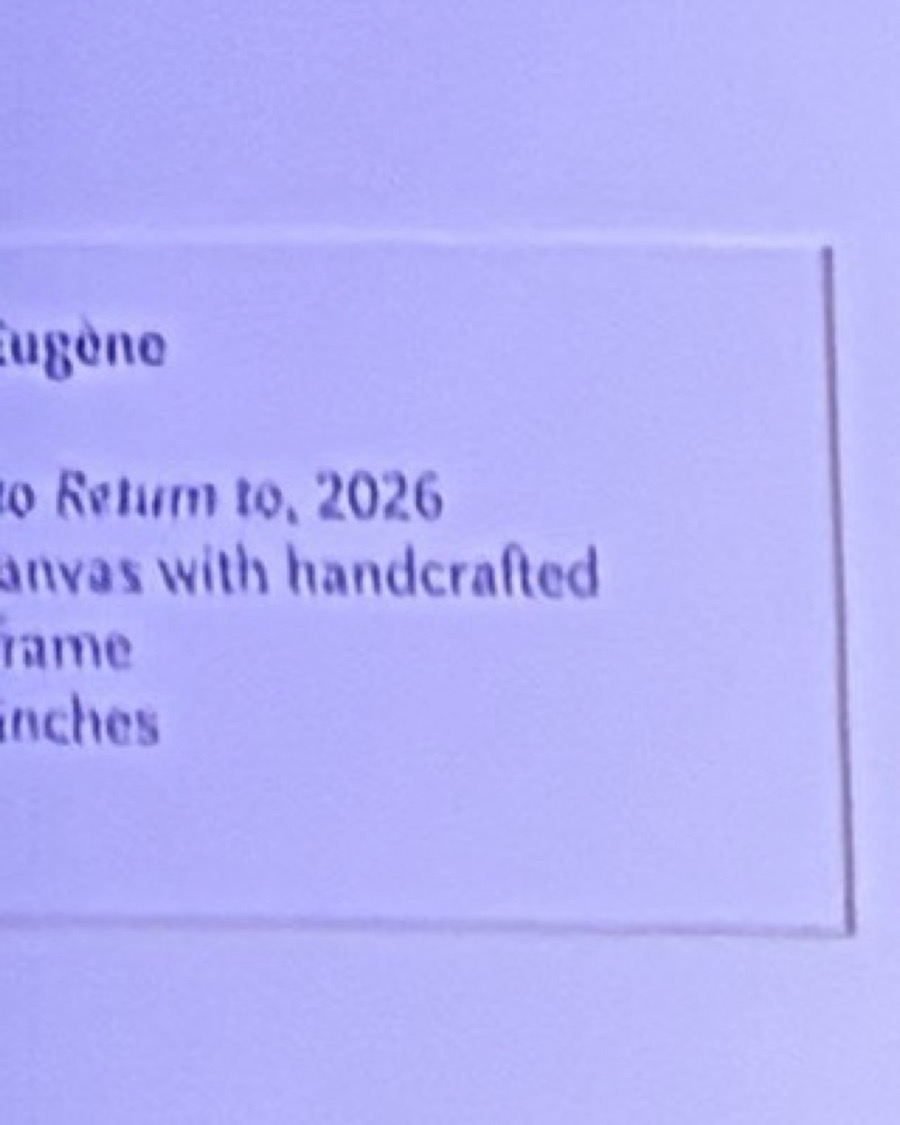
The first words of the title and the dimensions ran off the edge of the photograph. One straight-on shot of the wall card finishes this entry.
Each entry above came out of a photograph. Not from recognising the painting, which is hard and unreliable, but from reading the small printed card beside it, which is neither. Here are two of them, exactly as they came off the phone.
What came out
ArtistPatrick Eugène
Title[…] to Return to
Year2026
MediumOil on canvas with handcrafted frame
Dimensionsoff the edge of the photo
The grave accent on Eugène came from here, not from a guess. The first words of the title and the dimensions are missing for the dullest possible reason: the photograph was cropped a few centimetres too tight.
Why it is called that
The front room was where you put what mattered and where you took people when they came. Michael McMillan built a whole exhibition around it, the most successful the Geffrye Museum had put on, with more than thirty-five thousand people through it, because everyone recognised the glass cabinet and the framed photographs and the things kept nice for company.
That is what this is. The room you take people to, and the record of what is in it.
It will not guess. If there is no label and no legible signature, it says so rather than inventing an artist. A record you cannot trust is worth less than no record at all.
Made by
Faith McCoy Scriven
Atlanta, Georgia · September 2026
Built the day after the David C. Driskell Prize Gala at the High Museum, where we bought a painting by Patrick Eugène and I realised I had no record of anything on our walls. Not the invoices, not the stories, not even reliable photographs.